- Web3 Investor Briefing by w3.group
- Posts
- Web3 Investor Briefing | March 2026
Web3 Investor Briefing | March 2026
Every month we provide you with insightful deep-dives into the world of Web3 investing.


Henrik Bredenbals & Julius Nagel
March 19, 2026
Welcome to this month's investor briefing featuring our latest analysis, findings and strategic insights from the Web3 ecosystem.
TL;DR
Julius from w3.wave notes how Micheal Saylor has found a new way to acquite Bitcoin and its implications, as well as a closer look at the recent liquidity picture and asset class correlations
Henrik from w3.ventures details the 2026 playbook for building a Web3 startup in the agentic economy.

Research: Strategy’s STRC and the Rise of Inelastic Demand
The evolution of Michael Saylor’s Strategy (MSTR) has moved beyond simple spot accumulation and into a new phase of financial engineering. The engine behind this is the Variable Rate Series A Perpetual Stretch Preferred Stock (STRC).
Unlike the convertible bonds that defined previous cycles, STRC is a perpetual equity instrument that effectively eliminates maturity risk and the threat of forced liquidations during drawdowns. It functions as a "digital credit" bridge, offering institutional fixed-income allocators a double-digit yield (currently ~11.5%) in exchange for funding the firm’s aggressive Bitcoin acquisition.
Saylor’s math for raising via STRC is simple: he argues that Bitcoin is an asset that will compound with an annual growth rate of 20-30% going forward. So if he can raise capital for roughly 11%, it should be good for his shareholders.
The efficiency of this model is striking. By pairing STRC issuance with common equity, Strategy maintains a disciplined ~33% net leverage ratio, essentially turning every dollar of new credit into roughly three dollars of Bitcoin purchasing power. We saw the scale of this "credit factory" last week when STRC trading volume hit a record $409 million, financing a massive acquisition of over 22,000 BTC.
For investors, the signal to watch is the STRC par value. During the recent market turbulence, the preferred shares briefly dipped to $96 but reclaimed the $100 par level within 48 hours. This rapid mean reversion is a powerful indicator of institutional confidence; as long as STRC holds par, the "Saylor Flywheel" remains in high gear. The primary risk remains a protracted Bitcoin bear market where dividend obligations could become a cash-flow burden, but for now, the model is successfully cannibalizing traditional high-yield demand to create a perpetual bid for Bitcoin.
The "Great Decoupling" is a Liquidity Story, Not a Safe-Haven Story
There has been significant debate over Bitcoin’s outperformance against Gold during the recent Middle East escalation. While some label this a "safe-haven shift," a deeper look at cross-asset correlations suggests it is rather a catch-up trade and a liquidity rotation.
1. Normalizing the BTC/Gold Lag
It is critical to acknowledge that Bitcoin underperformed Gold for nearly five consecutive months leading into 2026. Gold’s rally to $5,400 was an overextended "flight to safety," while Bitcoin experienced in a brutal drawdown toward $60,000.
The recent 20% surge in BTC while Gold fell 3% isn't necessarily a change in Bitcoin's fundamental DNA; it is a mean-reversion event. Capital that was "parked" in overcrowded Gold positions is rotating back into a severely oversold Bitcoin as geopolitical panic subsides and institutional "dip-buying" commences.
2. Cross-Asset Mechanics: USD and Equities
The true "regime change" is found in how Bitcoin reacted to the U.S. Dollar (DXY) and Equities:
The Dollar Strength Paradox: Usually, a DXY rally (which we saw this month as it hit a 10-month high of 101) is a headwind for BTC. However, BTC rallied with the dollar. This is a local change from Bitcoin’s characterization as a pure "risk-on" technology beta.
Equity Decoupling: While the S&P 500 remained relatively flat or slightly negative due to "higher-for-longer" rate fears and stagflation concerns, Bitcoin staged an 8-day winning streak.
Summary: We shouldn't misinterpret a "catch-up trade" for a permanent safe-haven flip. Bitcoin remains a high-beta liquidity vehicle. However, the structural inelasticity provided by players like Strategy, combined with a rotating institutional bid out of over-leveraged Gold positions, is creating a market structure that is far more resilient to macro shocks than in any previous cycle.

Gold vs Bitcoin - this is a monthly chart so you can decide for yourself if this looks like it wants to go up (Gold outperformance) or down (Bitcoin outperformance)

The 2026 Web3 Venture Playbook: Building for the Agentic Economy
Building in the digital asset ecosystem of 2026 requires a fundamental shift in perspective. We have moved definitively past the era of "Web2 with tokens" and entered the Read-Write-Own paradigm.
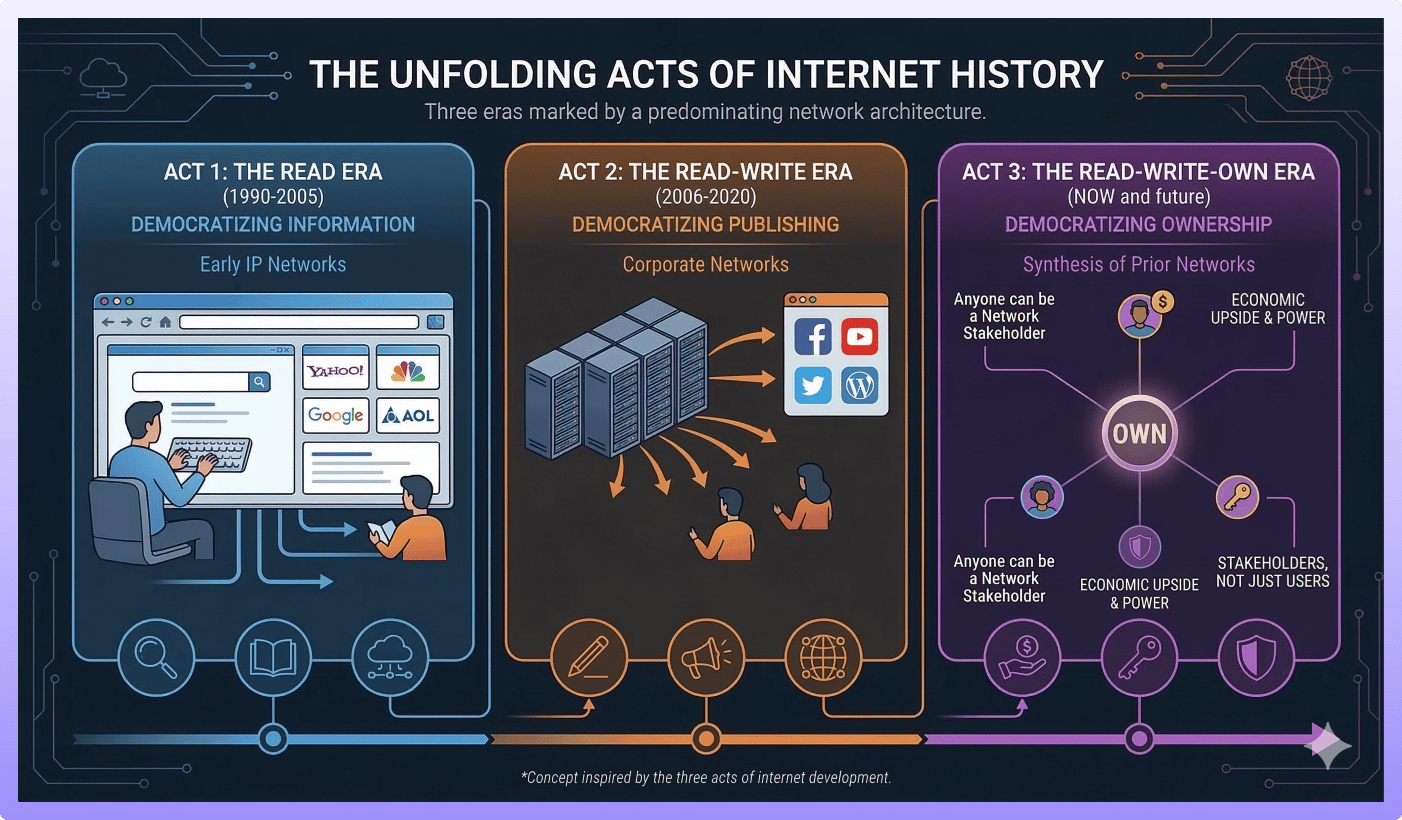
In this landscape, the core value proposition of a venture is no longer just providing a service, but providing the trust layer and economic rails for an internet increasingly populated by autonomous software agents. This playbook outlines the strategic milestones for founders navigating this transition, from initial protocol design to the high-stakes reality of "sufficient decentralization."
Phase I: Foundation and the Missionary Culture
The first and most critical rule of the 2026 playbook is the preservation of the "Missionary" culture. In the current market, talent optimizes for ownership and vision rather than just salaries. Founders must distinguish between missionaries, who are those who are in love with the product's long-term utility, and mercenaries, who are purely motivated by short-term token appreciation. Because Web3 talent is essentially incentivized by equity-like tokens, mercenaries often disappear during the inevitable 90% drawdowns of a bear market, whereas missionaries continue to ship through the crash, as seen in the resilience of protocols like Aave and Uniswap.
During the foundation phase, the focus must remain on a "Read-Write-Own" thesis. This means restructuring systems so that users who contribute value actually capture it directly through embedded ownership primitives. Founders should resist the urge to launch a token or decentralize governance too early. The playbook suggests that you get only "one shot" at a token launch; doing so before achieving product-market fit (PMF) often leads to a community optimized for price action rather than protocol success. In our opinion, there are also cases of highly successful ventures that remain fundamentally "Web3 tech-enabled" without ever requiring a native token, relying instead on sustainable revenue models such as infrastructure licensing or service fees. PMF in 2026 is a three-dimensional metric: it requires technical utility, community alignment (where the community serves as "user success infrastructure"), and economic viability that generates real protocol revenue.
Phase II: Architecture for Agentic Commerce
As the protocol matures, the 2026 playbook mandates the integration of agentic commerce infrastructure. This is the structural inflection point where AI agents, defined as autonomous programs capable of observing conditions and taking financial action, become the primary users of the internet. Because these agents cannot open traditional bank accounts, they require crypto-native rails to survive.

The technical backbone of this transition is the x402 protocol. By "awakening" the long-dormant HTTP 402 "Payment Required" status code, x402 allows money to move as seamlessly as data. When an AI agent encounters a paid resource such as a data feed or GPU compute, it receives a 402 response, signs a gasless stablecoin authorization, and retries the request. This eliminates the need for pre-arranged API keys or traditional credit card networks, enabling a "just-in-time" economy where software pays software directly in stablecoins like USDC.
Phase III: Selling the Result, Not the Tool
The most significant shift in business models in 2026 is the transition from "software" to "services." In the previous model, you sold a "Copilot," a tool that helped humans do their jobs better. In the new model, you sell an "Autopilot," an AI that performs tasks for customers.
Rather than charging a monthly "per-seat" fee, you charge for the outcome, such as a resolved support ticket or a filed tax return. This represents a significant economic opportunity because builders can finally access the "work budget," which is historically six times larger than what companies spend on software alone. However, be wary of the "outcome trap." If you only charge based on efficiency gains, the vendor may capture all the profit that belongs to the customer. The winning strategy is to act as an "AI-native managed service" that takes full responsibility for the outcome, ensuring that your revenue grows as the AI's performance improves.
Phase IV: Operational Resilience and Decentralization
In 2026, scaling a venture requires striking a delicate balance between leadership and personal safety. Founders must navigate the Product CEO Paradox by staying deeply involved in technical protocol design, where mistakes are permanent, while delegating operational growth to specialists. Founders must also take ownership of their narrative. They cannot outsource this responsibility to PR firms, but rather must use a direct-to-community framework that focuses on business goals and target audiences to maintain trust.
As you achieve success, your physical security becomes as critical as your code. The playbook requires a secondary wallet strategy: keep only 5–10% of your holdings in a safety wallet that can be surrendered under duress. Being publicly associated with crypto wealth makes you a permanent target for sophisticated criminals.

The ultimate goal is sufficient decentralization, which transforms the protocol into a piece of "public infrastructure" that no longer relies on the founding team for its value. This transition is essential for compliance with the 2025 GENIUS Act, which establishes the federal framework for regulated stablecoins. Founders can ensure their venture becomes a permanent, autonomous utility for the global digital economy by integrating with major liquidity pools and avoiding the isolation of "decentralization theater."